Skip to content
The Future of Google Search with AI (Part 1 of 2)
Google
This is the first in a two part series examining the future of Google Search in an AI first world. We present findings from our study of 200 queries designed to better understand how Google is using and monetizing AI Overviews and AI Mode. The second report coming out on later this week, will look at what Google may be developing next to help save and potentially advance Search.

Key Takeaways

Google's June quarter commentary reassured investors that AI is expanding search activity and engagement, while monetization remains in early testing.
We conducted a 200-query test across ten commercial categories to evaluate how Search, AI Overviews, and AI Mode work together.
Our testing found no ads in AI Mode, which made sense given they are just beginning to test ad placements in that experience.
Google appears to be positioning AI Overviews as the primary AI feature in Search, with limited monetization, while AI Mode is an option for more complex queries.
What popped out of our study; the value proposition for AI Mode remains unclear.
1

Google’s June Quarter View on AI in Search

In June, Search grew 11% y/y, a step up from the 10% reported in March. This improvement surprised me. Following Eddie Cue’s comment early in May that Google searches on Safari declined for the first time, I was in the camp that we would see a slowdown in growth quarter over quarter. The opposite happened, underscoring how habitual Google is in our lives.

On the June quarter earnings call, Google management emphasized that AI is driving an expansion in Search activity and that the company is prioritizing user experience ahead of monetization. That means they are being slow to show ads in AI Overviews or AI Mode because they don’t want to scare away users.

Google’s CEO, Sundar Pichai noted that new generative AI features are motivating Google users to ask new kinds of questions, leading to higher engagement and increased query volumes, especially among younger users. Overall search queries, including those with commercial intent, grew y/y, another sign that the Google franchise is intact. The company noted that AI Overviews, which are now integrated into the Search results page, have reached over 2B monthly users globally, about 40% of what I estimate to be their total monthly users. These overviews drove a 10% increase in query volume for queries that include them.

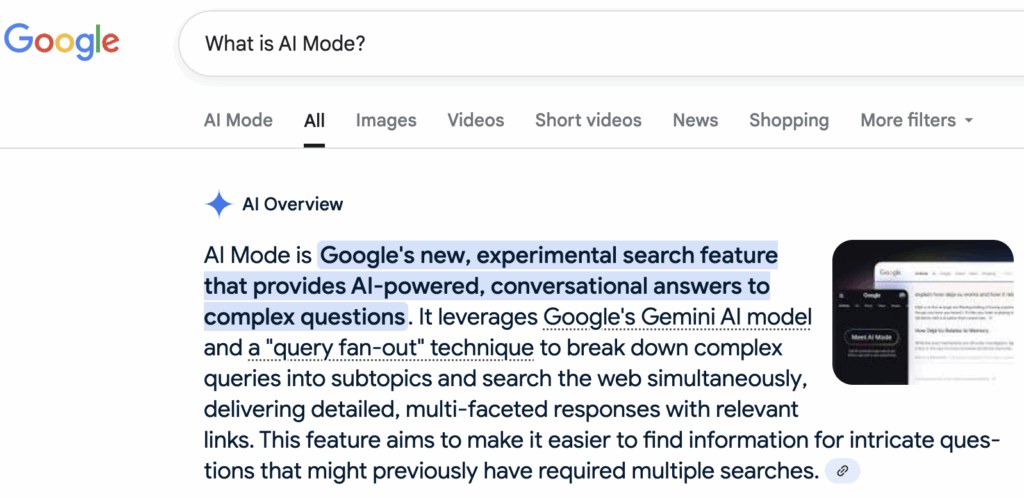
As for AI Mode, it’s still in early rollout. The company reported it reached 100 million monthly active users by the June quarter, or 2% of global MAUs. Adjusting for the fact that AI Mode was only available in the US and India in the quarter suggests AI Mode reached 8% of the potential users. Going into the print, I would have estimated that number to be around 1%, suggesting there has been materially more AI Mode engagement than I would have expected.
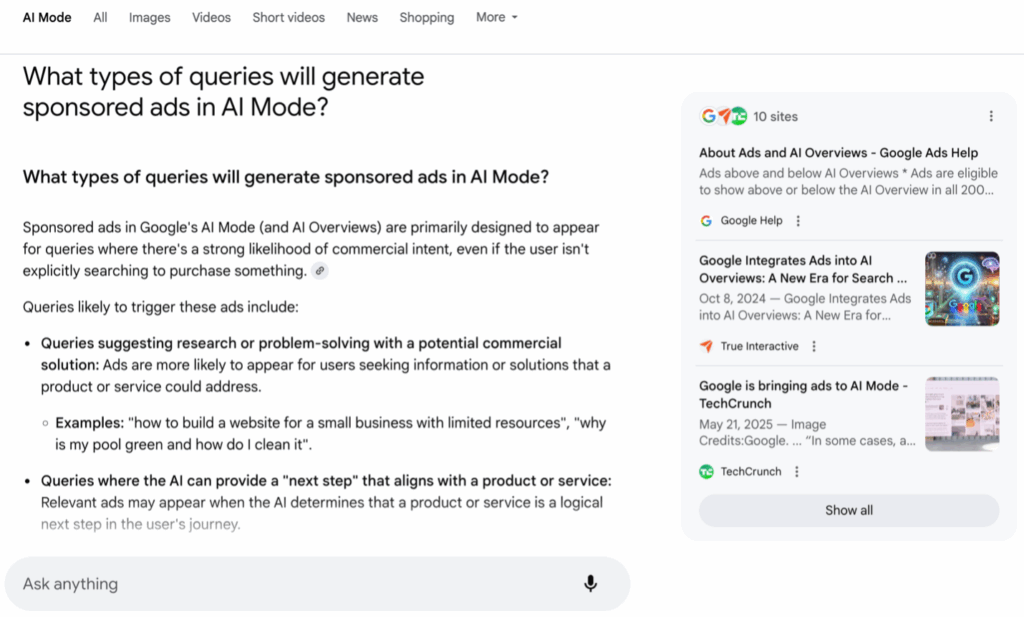
Monetization of these AI experiences is of course still early. Google has reiterated that it is prioritizing the organic experience both in Search and its Gemini AI assistant, while delaying making money on Overviews and AI Mode. The company said that ads within AI Overviews are monetizing at rates comparable to traditional Search. I view this as a validation of the format and a foundation for future ad products. The bottom line on monetization is they ramped AI Mode and Overviews with little to no monetization, and overall Search growth improved quarter over quarter.
2

200-Query AI Mode Test: Methodology

To better understand how Google is implementing its AI Search features, we ran 200 queries through both the standard Search interface and the new AI Mode. Queries were selected across ten commercial categories: Home Services, Personal Finance, Health Products, Small Business, Tech and Electronics, Travel, Parenting, Beauty, Automotive, and Pets. Each category included 20 queries designed to trigger AI responses. To reiterate, the majority of these queries had clear commercial intent, such as best laptop for graphic design or cheapest car insurance in California.

We began each search on the classic Search page to record whether an AI Overview appeared and whether ads were shown. The same queries were then run through AI Mode to observe whether any ads appeared.

For example, in the Home Services category, we tested both best home security systems and how to fix a leaky faucet. In the traditional Search interface, 81% of the queries generated at least one ad, and 61% triggered an AI Overview. We also monitored whether any of the AI-generated summaries contained ads. Finally, we assessed the same 200 queries in AI Mode to see if we could spot an early ad.

3

No Ads Yet in AI Mode

Across the 200 sessions we tested using AI Mode, we found no ads. While we were disappointed that we struck out in our quest to find an AI Mode ad, that outcome was largely expected given how early we are.

We believe the current test group is small, possibly limited to tens of thousands of daily users in the U.S., a fraction of my estimate that Google has 250 million daily US search users. If 30k people are seeing ads in AI Mode, that implies about 0.012% of daily U.S. users are in the test bucket.

This micro test group is consistent with Google’s stated approach of validating new formats at a slow pace.

The bottom line, our survey underscored that any contribution from AI Mode will be fractional over the next one to maybe two years, especially considering that AI Overviews launched 14 months ago and its hard to find an ad in that format.

4

AI Overviews vs AI Mode: Usage and Key Metrics

Our study offers a view into how Google is currently balancing its two AI powered search features.

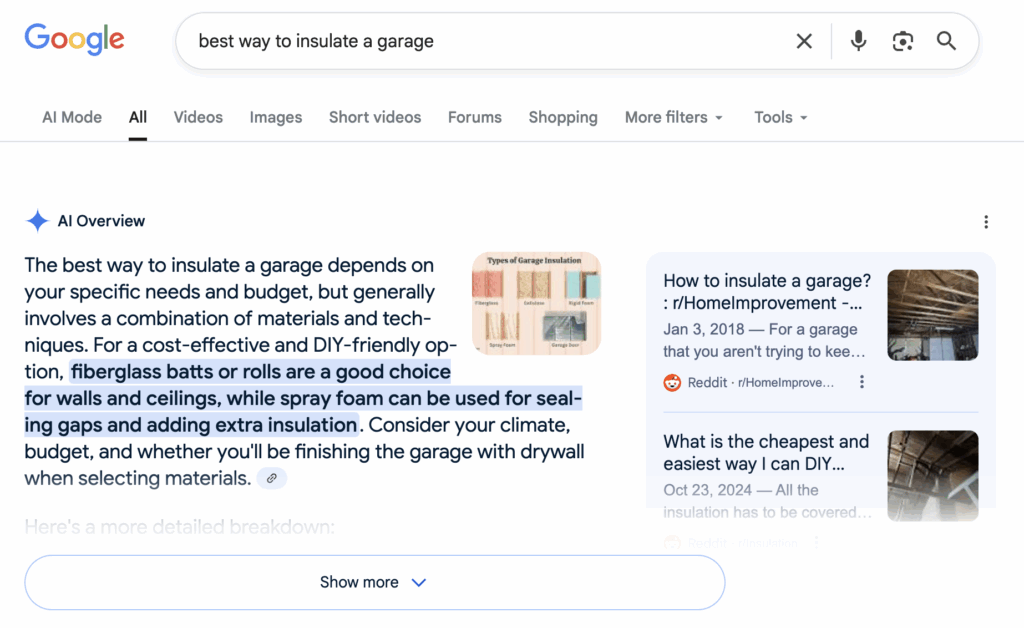
AI Overviews appeared in 61% of the queries tested. Their placement, typically above the first organic result, suggests they are becoming a core part of how Google surfaces answers. Despite their widespread use, only 0.8% of these AI Overviews included ads, underscoring how slow they’re moving. Keep in mind, AI Overviews kicked off more than a year ago, in May of 2024.

AI Mode, by contrast, was manually accessed for each query in our test. It’s available as an option for all search results but does not automatically launch. In most cases, we did not feel a need to launch AI Mode given AI Overviews gave us what we were looking for.  The two tools seem to operate as complementary layers, with the overview as the primary feature and AI Mode reserved for specialized cases.

5

Unclear Value Proposition for AI Mode

The most significant takeaway from our study is that the use case for AI Mode remains vague.

We found it difficult to identify examples where a we preferred AI Mode over the standard Search experience or a chatbot. Part of this stemmed from our searches and prompts having an underlying commercial intent.

Google describes AI Mode as a conversational, chatbot-like environment best suited for multi-step queries.

While that positioning makes sense, we found that most of the time what we were looking for was already available on the main Search page. For example, a query about comparing two types of insurance provided a clear and concise summary on the Search page. Entering AI Mode did not yield additional value, only a longer version of the same answer. We found little incentive to switch interfaces.

Our bottom line; AI Mode experience feels optional at best and unnecessary at worst.

Sundar has hinted that the long-term goal is to unify Search, generative AI, and assistant features into a single “one surface” experience. Our observation around AI Mode’s shortcomings, along with Sundar’s long-term hint, got us thinking about what might be next for Google beyond AI Mode.

Over time, we believe the current separation between traditional Search and AI assistant functions will give way to a more unified interface that adapts to user intent. Stay tuned to our next report.

Disclaimer

Back To Top