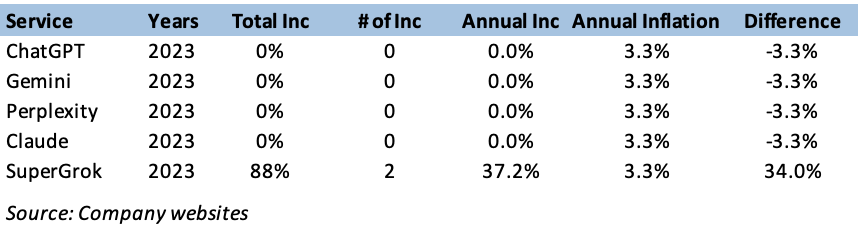
Paid consumer app pricing changes
We tracked pricing changes for the 10 most popular paid consumer apps over the past 20 years to get a better sense of what happens when consumers get hooked on an app. On average, we found annual price increases of 5.2%, which tracked ahead of the average rate of inflation at 3.8%. It’s worth noting that the inflation number is based on the years these apps were available, which gives greater weight to the past five years compared to the early years when fewer of these apps were in the market. In other words, prices increased on an annual basis 1.7% faster than inflation, a gap that underscores the stickiness of these apps.
Below is a recap of pricing changes. Note that Apple TV+ price changes are based on a $7.99 starting price in 2019, even though the actual launch price was $4.99. We used $7.99 because the $4.99 was viewed as a temporary introductory price. If we had used the $4.99 starting price, the gap ahead of inflation would increase from 1.7% to 2.3%.
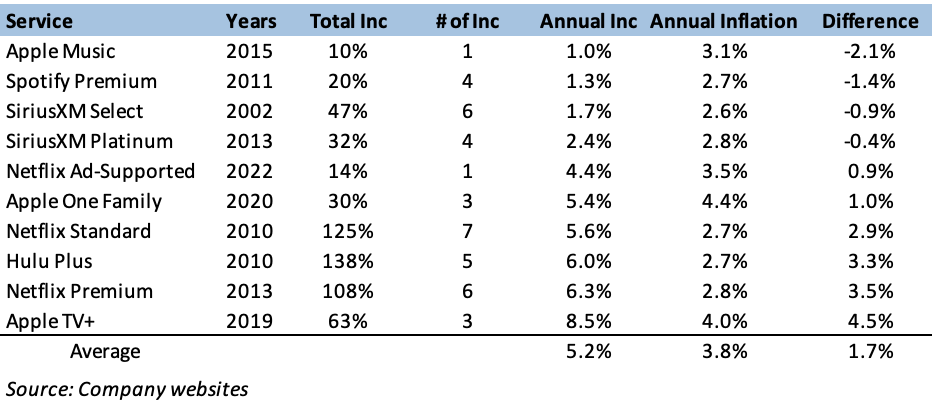
This data is important for two reasons.
First, consumer subscription apps will be an important mode of monetization for LLM providers. As a point of reference, it’s rumored that 80% of OpenAI’s revenue (around $15B this year) comes from the $20 and sometimes $200 monthly ChatGPT subscription. If you’re curious, the other 20% of revenue comes from token sales to enterprises and research checks. The company doesn’t disclose the number of paid subs, only that they have over 850m total weekly users. That gives us enough to back into the paid sub number, which is likely between 60-70m at the end of October. Next up is Gemini, which I estimate has about 15-20m paid subs at $20 a month, followed by Grok and Claude at under 10m.
Second, the data shows there is pricing power ahead of inflation.
Third, it shows that apps that essentially do the same thing (content in the case of our study) can still show pricing power. This speaks to the concern that it’s hard to distinguish between the chatbots, and it’s comforting to see that it’s also hard to distinguish between these paid content apps that are all raising prices.