Skip to content
5 Key Pressure Points for Mag 7 Earnings – Plus an NVDA Bonus
Amazon, Apple, Google, Meta, Microsoft, Nvidia
Here are the five pressure points for this Wednesday and Thursday’s earnings from Google, Meta, Microsoft, Amazon, and Apple (and an Nvidia bonus). Big picture: The setup carries more risk than it did three months ago, as investor confidence is notably higher heading into this round of reports. That said, the key takeaway will likely remain that we are still in the early stages of AI adoption, and the largest technology companies continue to hold their ground.

Key Takeaways

Investor confidence is elevated heading into this week, which presents a reason for near-term caution.
Commentary on next year’s CapEx needs to suggests higher growth for Google and Amazon, with no changes for Microsoft and Meta.
Cloud growth is steady to accelerating, yet all three providers continue to face supply constraints.
Google has likely been successful in navigating changes to consumer search behavior.
iPhone is likely to fall short of the September whisper, but December guidance should point to growth above Street expectations.
What does the CapEx guide mean for Nvidia? Google and Amazon need to hint at up 20% for next year.
1

A Bullish Vibe

My near-term rule is: when investors are nervous, it’s time to be bullish; when they’re bullish, it’s time to be cautious. My sense is that the bullish outlook among big-tech investors entering this week presents some risk.

Taking a step back, the performance of these five companies over the past three months has been mixed. META and MSFT shares are up roughly 5%, while AMZN is down 2%, compared to the Nasdaq, which is up 11%. On the other hand, AAPL is up 24% and GOOGL is up 39%. In other words, while AAPL and GOOGL are carrying high expectations, investors also appear optimistic about Meta’s ad business and AWS growth in September.

Looking back at expectations heading into June earnings, the focus was on Google Search, which was anticipated to show slowing growth, and the iPhone business, particularly in China, which was expected to remain weak. In reality, Google’s search growth accelerated from March to June, and the iPhone posted its strongest growth since FY21, even after adjusting for the pull-forward of revenue from U.S. consumers anticipating a tariff-driven price increase. As an aside, Apple’s China business grew at 4.4% in June after being down 2.3% in March and down 11% in December of 2024.

2

CapEx

When it comes to the AI trade broadly, and the semiconductor trade more specifically, it all comes down to CapEx outlook.

Over the past six quarters, out-year growth rates have consistently moved higher. This has allowed semiconductor providers to exceed expectations despite rising numbers, effectively defying the law of large numbers. This dynamic makes sense given that companies like Nvidia derive just over 63% of their revenue from six key customers (Meta, Microsoft, Google, Amazon, Oracle, xAI), up from 55% a year ago.

So where does the 2026 CapEx bar sit heading into earnings? With the whisper numbers, not the in-print estimates.

Here are the current estimates:

It’s worth noting the gap between Meta’s commentary in the June earnings call and Susan Li’s remarks at the Goldman Tech Conference on September 9th. Meta indicated growth of over 40% next year, well ahead of Google, Amazon and Microsoft, who did not provide 2026 guidance.

This left analysts to set the growth bar for Google and Amazon at just over 10% y/y. In reality, Meta’s large CapEx growth target has set the tone. I believe Google and Amazon will need to signal that their CapEx growth next year will exceed 20% from 2025. I expect the it will be a neutral if Microsoft maintains its estimate of 22% CapEx growth for CY26.

3

Favorable Cloud Outlook

As a level set, here are the in-print Street estimates for the cloud providers:

Notably, the Street expects both Azure and Google Cloud (GCP) revenue growth to slow q/q, while Amazon is expected to accelerate.

I believe this represents a realistic baseline, with whisper numbers generally aligning with the in-print expectations. If Azure and Google approach the growth rates seen in June, investors should be satisfied, as September growth would then exceed what was reported in March 2025. Conversely, the AWS bar calls for a step-up in growth: the expected 18.1% increase (up from 17.5% in June) remains materially below the expected growth rates for Azure and Google (30% and 38%, respectively).

The message of being supply-constrained is likely to continue. Another factor contributing to high cloud expectations is that, last quarter, all three major providers flagged supply-capacity constraints (hardware, datacenter build-out, AI infrastructure) as limiting factors in fully accelerating growth. In other words, they indicated growth would have been higher absent these constraints, which elevates expectations for September and December. I expect the messaging around supply constraints to remain consistent across all three providers in the upcoming earnings reports.

4

Google Search

As an analyst and investor, I overweight what a company says just before they report earnings. Typically it’s a moot point because companies rarely say anything material in the six weeks before reporting, given most of them impose quiet periods. That dynamic is even more in play with the biggest companies, given they’re hyper-sensitive to sending a message before earnings that may be perceived to conflict with reported results.

In my time in tech, I can’t remember a period when Google has been more aggressive with an investor charm effort. Shortly after earnings, Liz Reid reiterated how well AI Overviews is doing to increase engagement. Then her October 10th appearance on WSJ’s ‘Bold Names’ upped the ante, given her comments leaned overwhelmingly positive on how Search is holding up.

The simple read: Google is going to have a good quarter in Search and continue to guide investors that they’re successfully navigating the profound shift in search. Street expectations for September have risen, with analysts now forecasting flat Search growth q/q. The whisper number suggests around 13% growth, which I expect Google to meet.

5

iPhone

Bottom line: I expect the favorable December guide to be a positive for shares of AAPL.

Taking a step back, the iPhone is on a roll. Beginning in the December quarter of 2022 through March of 2025, growth had been mostly flat, averaging a 0.5% y/y decline. In June, however, it sprang back to life, rising 13%, aided in part by a couple of percentage points of growth (Deepwater estimates) from customers pulling forward purchases ahead of potential U.S. tariffs. Cook noted that roughly 1% of the company’s overall 10% growth came from this pull-forward effect.

Here’s a look back at iPhone growth and in-print expectations.

For the September quarter, the Street now expects 9% y/y iPhone growth, up from roughly 6–7% just after the prior quarter’s report. A closer look at estimate revisions shows most of the change occurred in the first three weeks of September. Since then, iPhone-related news has continued to be positive, even though analysts have not materially adjusted the consensus. Notable indicators including JD.com comments from China, improved lead times across the board, and third-party data from Counterpoint, suggest September will be a strong quarter.

I believe the recent positive developments have raised the bar for this print. My guess is the whisper number is around 10% growth.

For the December quarter, Street expectations call for 6% growth, which I sense aligns with buy-side expectations. I expect iPhone commentary on the earnings call for  December will indicate growth above 6%, closer to 8%.

6

Nvida

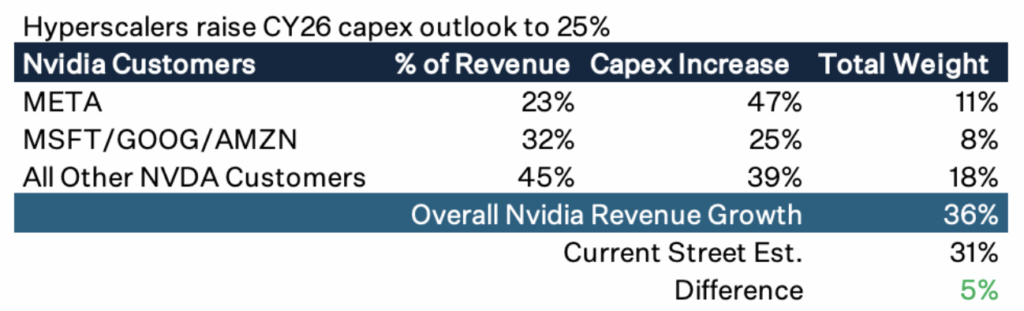
Given that just over half of Nvidia’s revenue comes from Google, Amazon, Meta, and Microsoft, the buy side is likely to recalibrate Nvidia’s growth expectations for next year based on comments from these companies this week.

Here’s the sensitivity:

  • A 2% upside to Nvidia’s revenue next year could occur if Microsoft, Google, and Amazon signal CapEx growth of 15% next year, compared with just over 10% currently.

  • A 5% upside to Nvidia’s revenue next year could occur if Microsoft, Google, and Amazon signal CapEx growth of 25% next year, compared with just over 10% currently.

  • A 12% upside to Nvidia’s revenue next year could occur if Microsoft, Google, and Amazon signal CapEx growth of over 40% next year, compared with just over 10% currently.


Disclaimer

Back To Top