
Skip to content
2025 Was the Year of the Robotaxi: Where Do We Stand Today?
Autonomous Vehicles, Google, Tesla
A lot happened in 2025 when it comes to robotaxis, which makes it fitting to mark where things stand today between Waymo and Tesla. This year, Waymo moved beyond the pilot phase and entered the scaling phase, with a fully driverless service operating in five US cities and a fleet of around 2.5k vehicles. Tesla’s Robotaxi is running a fleet of around 50 vehicles, largely supervised in Austin and the Bay Area. While Waymo has the lead, the market remains nascent, likely exiting 2026 with about 1% of rides in the US, which means Tesla has plenty of time to catch up. For 2026, it will all come down to how the no safety driver Austin test goes. If that goes well, look out Waymo.

Key Takeaways

The Baseline: Waymo is now delivering about 450k paid rides per week compared to our estimate of around 5-10k per week at Tesla.
Waymo: Operating at commercial scale and rapidly expanding.
Tesla: Operational fleet is tiny but will likely leapfrog Waymo over the next few years pending completion of FSD and regulator approval.
Winning regulator approval is the main obstacle for Tesla's Robotaxi going mainstream.
1

The Baseline

It’s difficult to compare specific performance metrics between Waymo and Robotaxi because Waymo reports on three metrics while Tesla reports on one. Waymo’s key metric is weekly paid rides, Robotaxi does not yet report this. Waymo reports total autonomous miles driven and Tesla reports all FSD miles driven, of which the vast major, 98% plus come from consumer-owned vehicles.

At a high level, here’s the baseline between the two:

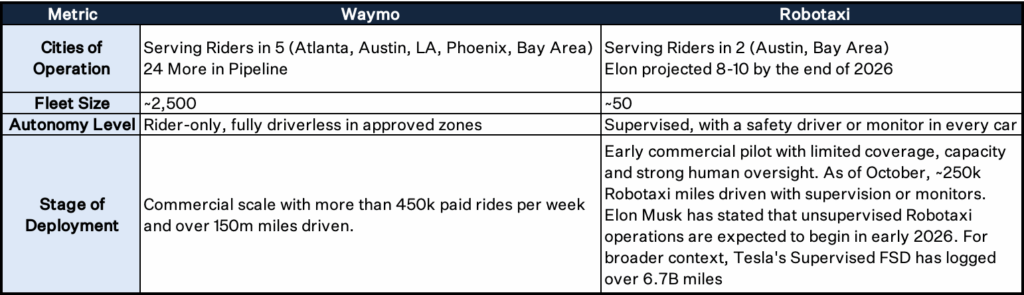
  • Waymo is running a commercial, driverless ride hailing service across five metro areas with an estimated 2,500 cars and doing 450k rides each week.
  • Tesla is running a supervised service in two cities, with a 3rd city in Arizona coming, using a fleet of what I estimate to be 50 vehicles. In Austin this week, they began testing a car without a safety driver and without riders.

To keep the comparison clean, it helps to focus on three shared metrics: cities, fleet size, autonomy level, and deployment stage:
2

Waymo Is Operating at Scale

Waymo’s most important development in 2025 is moving from testing to scaling phase. Earlier in the year, the company crossed roughly 100m miles driven with no human behind the wheel and is now adding more than 2m fully autonomous miles per week which puts today miles at about 150m miles driven. On top of that mileage, as mentioned in the previous section, paid rides have ramped to around 450k per week, up from 250k in April, supported by a fleet of about 2,500 vehicles.

In practical terms, Waymo is no longer asking “does this work?” It is working on “how big can this be?” and “how efficient can we make it?”

Waymo’s has commercial operations are in the following cities today:

  1. Phoenix metro
  2. San Francisco Bay Area
  3. Los Angeles
  4. Austin
  5. Atlanta

In these cities, Waymo runs rider only service within defined service areas. Over the past year, it has:

  • Opened up freeway routes in places like Los Angeles, Phoenix and the Bay Area, which increase miles per vehicle and cut trip times on longer routes.
  • Expanded service maps and removed waitlists in select neighborhoods, bringing down average wait times.
  • Added airport access in some markets, a key use case for ride hailing generally.

Beyond those cities, Waymo has begun testing or early operations in a growing list of future markets, including:

  • Miami
  • Minneapolis
  • Several Texas cities
  • Detroit
  • Multiple Mid Atlantic metros.

The pattern is consistent: mapping and supervised driving first, followed by progressive steps toward a full rider-only service.

As the network has grown, the service has started to feel more like a “normal” ride hail product for many riders:

  • Pickup times and coverage are improving.
  • The driving style has become more confident and less hesitant compared with early years, particularly around merges and dense intersections.
  • Integrations with existing ride platforms, both Uber and Lyft, allow Waymo to tap into established demand without building its own rider funnel everywhere.

At the same time, scale has surfaced shortcomings of the service. Incidents around school buses and emergency scenes have led to regulatory scrutiny that has resulted in model updates. So far, those have resulted in recalls and corrective updates, not shutdowns, but they highlight that even a mature robotaxi system needs continuous refinement, which means a meaningful amount of improvements will still be needed by both companies for the services to go mainstream.

3

Tesla's Fleet

Today it’s advantage Waymo. That narrative can quickly change if Tesla can launch a fully autonomous operation in Austin and expand to other cites, and unsupervised FSD reaches a level ready for state-by-state approval.

Tesla’s Robotaxi program is making measurable progress, but remains in an early phase. In Austin and the Bay Area, Tesla operates a small fleet of Model Y vehicles running FSD (Supervised) within a defined service area. Rides are booked through Tesla’s own app. A trained human remains in the front of every vehicle, either in the driver’s seat or passenger seat, to monitor and intervene when necessary. This week the company began testing a version without a safety driver. While Elon has not giving any timing of when to expect the safety drivers will be removed, my sense is they will reach that milestone before mid 2026.

The key metrics:

  • An estimated 50 Robotaxis in the fleet today.
  • A plan to ramp to roughly 100 vehicles in the next two months, which is below earlier targets hundreds of cars in the city by the end of 2025.
  • Outside of Austin and the Bay Area, Arizona has granted Tesla a statewide permit for a paid Robotaxi service, which also starts with safety drivers on board.

The leapfrog:

  • Once unsupervised operations are approved in Austin, this will clear a path for Tesla to ramp up in other cities and states.
  • As a reminder, Tesla needs to gain approval for Robotaxi operations in each location, there is no one-time federal approval.
  • The real kicker is when FSD is validated (Unsupervised). This will enable Robotaxi capability on 2m existing Tesla’s in the US through software updates.
  • My estimate only includes US based Model Ys & 3s with Hardware 4 (started in January 2023). That 2m number is well above the roughly 460k vehicles I believe would be needed in 2030 to support 70% of market share of the US ride hailing market. That implies each car works 300 days a year, and does about 27 rides per day (about 2 per hour considering a 12 hour work day).

The production cost advantage:

Tesla, of course, plans to service its network through a combination of Cybercabs which are not in production today which are expected to have a cost of around $25k per vehicle and owned and operated Model Y & 3’s with an average production cost of around $35k. This compares to Waymo Jaguar I-Pace vehicles which today cost an estimated $150k per vehicle. Its newer, purpose built Zeekr RT models are designed to be cheaper, roughly around $80k each likely by 2027.

The cost difference conversation falls into the category of don’t over think it. Tesla is the most efficient manufacturing of EV’s in the US. Just ask Ford what they’ve learned over the past three years, deciding to end production of key models and take a $19.5B charge to reduce its EV footprint. The likelihood that Waymo working with a third party, absent BYD, to produce an autonomy powered EV for close to Tesla’s cost is slim to none.

4

Regulation Roadmap

Regulatory approval is the main obstacle for Tesla’s robotaxi going mainstream. Elon’s made that clear over the past six months, mentioning the regulator hurdle nine times on the company’s June and September 2025 earnings calls.

So what does it entail to gain regulator approval? To understand the process let’s start with how NHTSA defines autonomy levels:

  • Level 0 – Momentary Driver Assistance: You drive, you monitor. Driver is fully responsible for driving the vehicle while system provides momentary driving assistance, like warnings and alerts, or emergency safety interventions. You drive, you monitor.
  • Level 1 – Driver Assistance: You drive, you monitor. Driver is fully responsible for driving the vehicle while system provides continuous assistance with either acceleration/braking OR steering.
  • Level 2 – Additional Driver Assistance: You drive, you monitor. Driver is fully responsible for driving the vehicle while system provides continuous assistance with both acceleration/braking AND steering.
  • Level 3 – Conditional Automation: System handles all aspects of driving while driver remains available to take over driving if system can no longer operate.
  • Level 4 – High Automation: A human driver is not needed to operate the vehicle. When engaged, system is fully responsible for driving tasks within limited service areas.
  • Level 5 – Full Automation: A human driver is not needed to operate the vehicle. When engaged, system drives, you ride. When engaged, system is fully responsible for driving tasks under all conditions and on all roadways.

Waymo and Tesla are operating under different regulatory realities today:

Waymo: Vehicles are classified as Level 4 autonomous systems, meaning they are allowed to drive without a human driver, but only in specific places and under specific conditions that regulators have approved. Waymo has already received approval to operate driverless robotaxi services in multiple cities by working directly with state and city regulators. Those approvals specify exactly where the vehicles can operate, when they can operate, and under what conditions. Regulators evaluate Waymo based on demonstrated safety performance within those boundaries, including incident reporting and operational controls. Once approved, Waymo can operate commercially without a driver and then expand gradually by securing additional local permits.

Tesla: Tesla’s consumer FSD software and Tesla’s Robotaxi service are regulated as two separate things. FSD is on customer vehicles, and is still legally treated as Level 2 driver assistance, which requires a human driver to remain responsible at all times. For Robotaxi, Tesla has begun following the same local approval model as Waymo. As of mid-2025, Tesla has received permission from the State of Texas and the City of Austin to operate a Robotaxi pilot in Austin. Within that approved area, Tesla is testing vehicles with no safety driver onboard, but only inside a small, geofenced zone and not yet as a broadly available commercial service. This approval came from compliance with Texas state law and coordination with Austin’s local authorities, which govern autonomous vehicle operations within the city. FSD remains regulated at the federal level as a driver-assist system. NHTSA does not grant approval for autonomous driving systems. It oversees vehicle safety through monitoring, defects, and recalls. The bottom line is there is no single top-down federal approval that can instantly authorize unsupervised FSD nationwide.

The bottom line on the Tesla regulator hurdle is simple. If over the next six months (to capture enough data) the Austin test with no safety driver goes well, the path to turning on new cities will be easy. If not, the regulator hurdles will get higher.

Disclaimer

Back To Top