

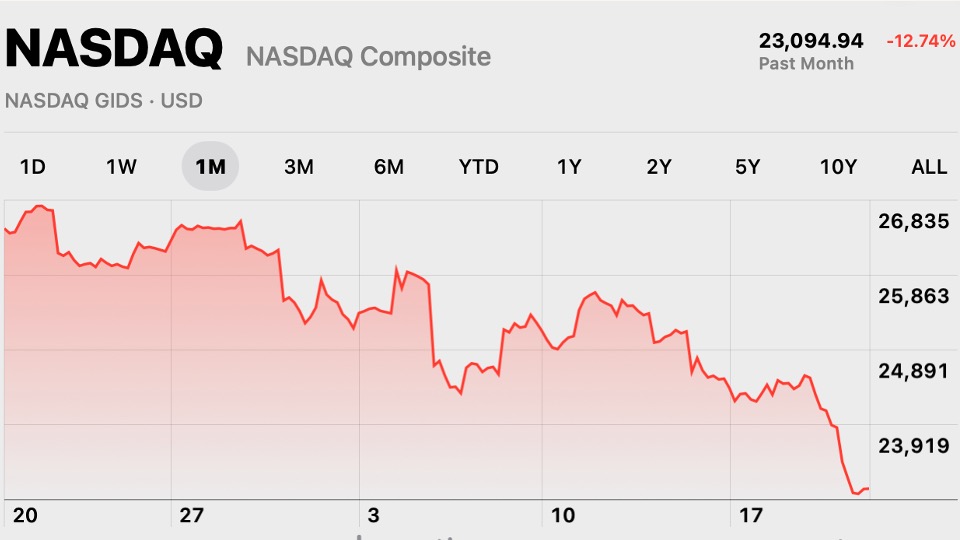
It’s easy to think we already have the answer to whether the AI bubble will burst. Over the past six weeks, many AI-first companies have traded down 30% – 50%. A drawdown like seems to confirm that we were in a bubble. In fairness, we won’t know the answer to that question for another few months, to see if we get a rebound.
Putting context around the recent sell off, since the start of October, the Nasdaq is down about 16%. That sell off compares to the roughly 24% six week drawdown we saw in early 2025 around DeepSeek and the fear of April 2025 tariff announcements. Recently the VIX has climbed from 15 to 31, but that jump is small compared with the move from 17 to 53 over two weeks during that earlier period. The reason I mention early 2025 is it felt there were more unknowns than today given the tariff wildcard was meaningful.
While we know AI trade is under assault, the central question now is how close are we to the bottom?
The unfortunate answer is that the sell-off will end when have more buyers than sellers. That sounds flippant, but it’s the reality. Investors know the fundamentals are strong today. The market is worried about what happens to future fundamentals if financing gets harder to secure and data center buildout slows. At its core, this sell-off is not about fundamentals, it’s about psychology. Investors fear we’re at the beginning of what will be multiple quarters of estimate cuts and that the worst is still ahead. That fear creates more sellers than buyers.
In the end I believe fundamentals will eventually prevail. That might take a few months to play out, but what I’m seeing is we’re still in the early stages of AI’s impact on the world and the window for investment gains remains open.
1. The lessons of the past
Before starting Deepwater, I was an equity analyst covering Apple at Piper. Part of my job was meeting with buy-side clients. Those meetings often included one or two portfolio managers and a handful of analysts. I remember one in November 2012, when Apple shares had fallen about 23% from May. Investors were worried that growth would slow, Apple’s multiple would compress, and the company would eventually miss Street estimates.
I argued that the iPhone fundamentals were still strong and that Apple would meet expectations. I thought the sell-off was overdone and the stock was a buying opportunity. While I was talking, and without saying a word, the portfolio manager stood up in and walked out, leaving the four analysts who had been sitting alongside him to carry on. His departure was calm. To me, it felt like I had the wind knocked out of me.
I asked the analysts what had just happened. One was willing to explain. He told me the portfolio manager thought I didn’t get it. First, the stock was trading on market psychology, and my positive checks weren’t going to change that. Second, he thought the market was going to be proved right and that Apple would miss its numbers in the near term.
I paid close attention to Apple’s multiple and the iPhone numbers after that meeting. Over the next two months, the stock traded down another 8%. The iPhone numbers came in line with expectations, and estimates held. In the end, he was more right than I was. I had the fundamentals right and the stock wrong. The goal of investing is to get the stocks right.
2. What might ease the fear
Guessing when the market fear will ease is hard to time. If I had to guess what’s feeding it now, it’s uncertainty about how big the AI buildout will be over the next couple of years. Investors are weighing the potential headwinds from a blue wave, how the buildout gets financed, whether Nvidia can keep playing the role of the “AI bank,” and what China export curbs mean for its business.
We’re probably about two months away from the first meaningful answers, when companies start reporting December-quarter earnings in late January. As for Nvidia, it may take longer for investors to get a clear view of their financing strategy and the impact of the China curbs. I’d expect investors to put more weight on those answers once they hear from the leadership that will have to carry out the strategy. Even disappointing updates on the datacenter front could help the market find its footing by giving investors something concrete to work with.
3. Reason for optimism
The good news is investors have an instinct to build and a capacity for optimism. That’s part of why I believe markets tend to rise over time and why I expect this period of fear to eventually give way to stabilization.
I think the next wave of AI could be more disruptive than what we’ve seen since 2022 with the chatbot and create bigger businesses than the ones we see today. Personalized agents are one early signal. Usage is still small, but the early signs I’m seeing suggest it’s growing quickly, and go from around 20m daily users to over 2B in a a few years. Physical AI is another, from autonomous vehicles and automated manufacturing to humanoids. Its impact could take a decade or more to play out, which gives it room to drive growth for years.
Long term, I expect AI fundamentals to prove stronger than investors expect over the next couple of years. The growth opportunities emerging from this buildout are what give me reason to be optimistic even when the market is not ready to think beyond the next few months.