
Skip to content
Tesla June Preview; More Moving Parts
Tesla
Tesla’s June-quarter earnings have more moving parts than usual. The bottom line is the long term growth story is intact, with the negative wild card around how the Street thinks about greater capex. New topics this quarter include expectations around capex, where I expect management to guide higher for next year, and gaining better visibility into whether the surge in June deliveries is sustainable. The traditional focus areas still matter. 1. automotive gross margins excluding regulatory credits, which I expect to come in above the Street’s 19.5% consensus. 2. updates to robotaxi rollout. Tesla has added three cities in July, and I expect management to indicate another three cities before year-end, broadly in line with Street expectations. 3. I expect the Cybercab production ramp to shift from late 2026 into the first half of 2027.

Key Takeaways

Getting a better understanding of what drove the surge in June deliveries, up 25% y/y compared with up 6% in March, is a central question for the call. I believe it was high gas prices and that this tailwind is sustainable.
I expect automotive gross margin ex-credits to be slightly above the Street's 19.5%.
The key long-term growth opportunities (Robotaxi, FSD, Cybercab, and Optimus) should all receive the “things are moving slowly and in the right direction” treatment from management on the call.
Last quarter, when the company guided capex to increase this year from $20B to $25B, it triggered a sell-off in after-hours trading, underscoring that the topic matters. I expect the company to guide to a number above $25B this year.
I put the odds at 80% that Tesla will be acquired by SpaceX within the next five years.
1

What Drove June Deliveries and What It Means for September

Tesla delivered 480k vehicles in June, up 25% y/y and about 18% above the Street’s 406k estimate. That compares with up 6% in March, down 16% in December, and up 7% in September 2025.

While I classified the June delivery number as a “monster beat,” shares traded down 6% on the day the numbers were released and have fallen another 7% since then. In total, shares are down 13% since the start of the month, compared with the Nasdaq being down 2%.

One overarching narrative regarding TSLA deliveries over the past couple of years is that they are less important now that the focus has shifted to Robotaxi, Cybercab, FSD, and Optimus. While I directionally agree, deliveries still matter to investors, as evidenced by the sharp decline in shares following the June report.

Gas Prices

So why did shares drop so much on a beat that exceeded the highest whisper number? Investors believe it was driven by high gas prices and that this growth driver is not sustainable because prices will soon fall.

In the June quarter, the average price of a gallon of gas in the US was about 30% higher than in the March quarter. In Europe, that increase was even greater, although I don’t have an exact average because an accurate reading depends on the weighting of sales in each European country. The bottom line is that gas prices skyrocketed globally in June and, in the first three weeks of July, have remained high, inching up another 2% in the US.

My view is that while gas prices had a measurable positive impact on Tesla sales, that’s okay because it is one of the reasons to buy an EV.

I also believe the high-gas-price tailwind can be a multi-year growth driver. Consensus thinking is that once the situation with Iran is settled, gas prices will quickly fall. I agree that we will likely see a rapid decline in the near term. Longer term, I believe gas prices are likely to remain elevated, given that the recent Middle East conflict underscores the region’s future potential to affect prices.

Discounting

Another focus of Wednesday’s earnings will be understanding underlying delivery demand through ASPs. Consensus has ASP at about $43.5k, up 5% y/y and roughly flat q/q. If that is correct, Tesla did not buy the delivery beat with price cuts. That matters because a 25% increase in vehicles with stable ASP points to more sustainable demand.

What It Means for September Deliveries

For the September quarter, the Street is looking for deliveries to be down 8% y/y because of the difficult comparison with growth of up 7% in Sep 2025, the only quarter in which deliveries grew. I expect the Street to revise expectations overall and look for flat y/y performance in September. For December, the Street is looking for growth of up 10%, which I believe is conservative given the easy comparison with down 16% in Dec 2025.

2

Automotive Gross Margin Ex-Credits

Auto gross margin ex-credits recovered from 12.5% in March 2025 to 19.2% in March 2026. The Street is looking for 19.5% in June. If that metric holds at 19% or better in June, it would show that the company is effectively managing a supply-constrained production environment while remaining profitable.

If auto gross margin ex-credits slips below 19% despite the strong delivery beat, that would likely be viewed as a cautionary sign regarding the company’s ability to ramp profits. My sense is that margins will be at 19.5% or better.

3

Robotaxi, Cybercab, FSD, and Optimus

While I don’t expect any meaningful updates on the key long-term growth drivers, I believe Elon will reiterate that everything is moving in the right direction.

Robotaxi

In the January investor deck, followed by similar language in the April investor deck, the company outlined or suggested that seven new Robotaxi cities would launch in the first half of 2026. In fact, it added three cities: Dallas and Houston in April, and Miami in early July and Tampa and Orlando on July 21.  These five cities are operating only a very small number of vehicles.

The bottom line is the launched 5 of 7 cities around the end of June (I’m giving the June quarter credit for the three announced in July). Yes, progress is slower than expected, but the company has been clear that predicting the exact timing of these launches in the near term is difficult. What’s more important is that the company is making progress in adding cities and removing safety drivers. That progress will likely support a faster expansion into new cities, potentially bringing the total to a dozen cities in the next year, which would mean seven new cities in 12 months.

As a point of reference, Waymo is now serving riders in 11 cities, compared with technically five cities for Tesla, although Tesla is operating on a much smaller scale.

One data point the company is providing is paid Robotaxi miles, which nearly doubled sequentially in March compared with December, reaching 1.7m through March. That suggests Robotaxi has about 3% market share compared with Waymo’s 97%.

Cybercab

Pilot production started in April at Giga Texas, engineering tests began in Austin on June 30, and volume production is still expected in 2026. Consensus still carries zero Cybercab delivery units through 2026, so any meaningful ramp is not reflected in the numbers. I expect an update on when volume production will begin, and I expect the language to shift to the first half of 2027.

FSD

Last quarter, Elon said that unsupervised FSD would reach customer cars by the December 2026 quarter. My sense is that few investors believe that remains on the table, given that the regulatory environment is the biggest governing factor in the rollout.

Optimus

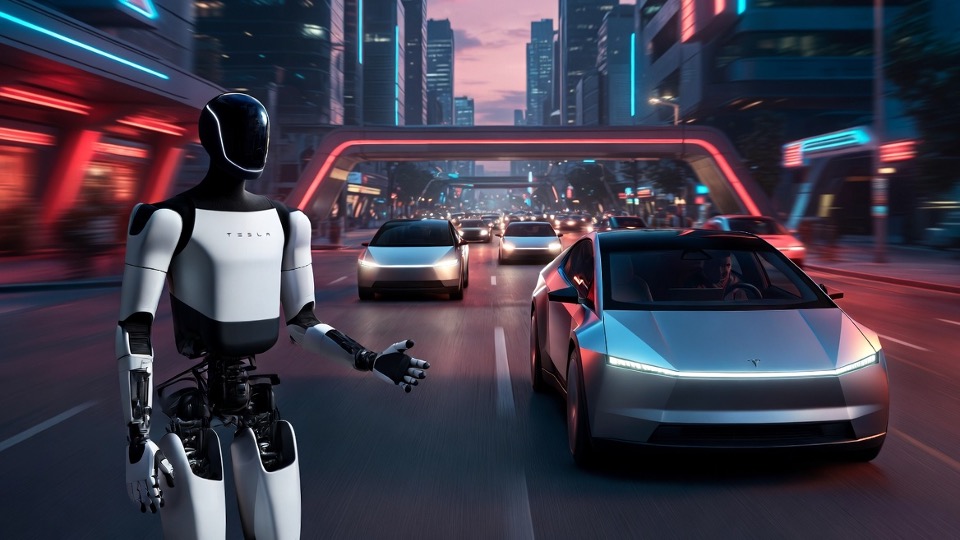
Elon has said that Optimus will be the biggest product ever, suggesting that, over the long term, it could account for most of the company’s revenue. The road to getting there is likely 15-plus years long.

Taking a step back, the last Model S and X units were produced in early May, clearing the way for Fremont to shift toward Optimus. Musk previously guided initial production to begin in late July or August, while also warning that output would be extremely slow at first because the robot has about 10k unique parts.

As for the timing of initial production, on the April earnings call, Elon guided for production to begin in the late-July or August time frame. My sense is that this target will slip to late this year.

Optimus targets have been slipping for the past year. In March 2025, Elon suggested that the company would produce 50k units this year. That expectation has long since been taken off the table and illustrates that investors should continue to view comments about the Optimus ramp through the Elon timing filter.

4

Capex Likely Going Higher

Last quarter, the updated capex ramp, increasing from $20B this year to $25B, triggered a sell-off in shares during after-hours trading, underscoring that this is a sensitive topic. The company attributed the increase in capex to a large investment phase that will last a couple of years. This will include six factories, some of which are already under construction, including Terafab for solar manufacturing equipment.

This all means that capex next year will likely be above the $25.6B expected today. Currently, the Street is looking for $25.6B in capex this year, declining to $21.2B in 2027. I believe analysts will leave Wednesday’s call expecting capex to be up in 2027.

It is a sensitive topic because it affects profitability and free cash flow. As a point of reference, in the March quarter of 2026, capex was $2.5B, and free cash flow was still positive at $1.4B. In June, capex is expected to be $6.7B, and free cash flow is expected to turn negative to the tune of $3.1B. In the September quarter, the picture is expected to worsen, with capex of $8B and free cash flow of negative $3.8B.

My view is unchanged: Higher capex is a good thing because it widens Tesla’s lead in autonomy, robotics, batteries, and energy. The company is using a strong balance sheet, with $31.2B as of the end of March, and will likely burn $10-15B over the next year, still leaving it with $15-$20B by the end of 2027.

5

Tesla-SpaceX Merger

Following the SpaceX IPO, chatter about Tesla combining with SpaceX increased based on the investor view that SpaceX needs to fill a large gap in its vertical AI ambitions: physical AI. Tesla is the leader in physical AI.

As it stands today, the market cap of SpaceX is $1.7T, and Tesla’s is $1.4T. I believe that, in the years ahead, the gap will widen, with SpaceX’s market cap increasing at a faster rate than Tesla’s, making it most likely that SpaceX would be the acquirer of Tesla.

As for the corporate governance hurdles involved in bringing two Elon companies together, I believe shareholders will approve the combination because it is in investors’ best interest to combine these two entities.

Disclaimer

Back To Top