

Skip to content
Tesla Deliveries Blow Past High Expectations, Lay Groundwork for Autonomy
Tesla
September deliveries of 497k were well ahead of the 475k high-end of the whisper, up 7% y/y after being down 13% in June and March. I believe the vast majority of the upside was driven by a 35% quarter over quarter jump in US sales from the tax credit, which in theory means investors should largely throw out the positive number. My "throw it out" logic misses a bigger point; the future will be autonomy and the ability to get EV units in the market profitably is a key competitive advantage. On that measure, the September deliveries are a long-term win for the company.

Key Takeaways

September deliveries were mostly inflated by the tax credit pull-forward.
The long-term win of the September delivery number: every car that Tesla profitably gets on the road increases its odds of success in autonomy.
I still believe December deliveries will likely be down around 5–10% y/y (the Street is at down 6%) as the pull-forward effect leaves a gap.
While I expect delivery growth to increase meaningfully next year, I expect it will end up about 10%, below the Street’s 17%. The growth story returns in 2027 as the new lower priced model hits its stride.
1

The September Spike

Deliveries of 497k raced past a 470–475k whisper range. The sell side had been raising numbers throughout the month of September, starting at around 440k, due to a combination of the success of the tax credit pull-forward and improvements in China.

I believe the China business did improve, and absent the tax credit would have yielded a meaningful improvement in deliveries to down 5% y/y compared to down 13.5% in June and 13% in March.

Tesla deliveries and growth rate:
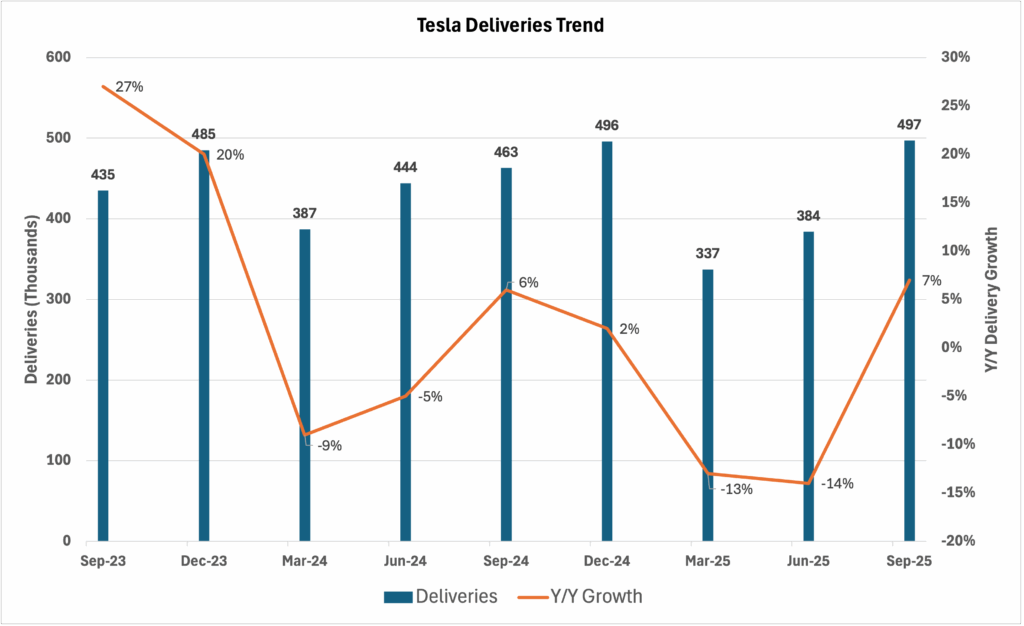
By my estimation, the tax credit added about 55k incremental deliveries, a massive number in the context that in the June quarter I estimate they sold just over 150k cars in the U.S. That means the credit sunset caused the U.S. business to spike around 35% quarter over quarter.

While that number is eye-popping, it’s reasonable given the context that prices of Teslas would increase an average of 15% following the end of the credit. Elon has talked about the price elasticity of demand in the past, and has used that view as justification to roll out a more affordable model next year. This makes me believe that a looming 15% increase in price could trigger a 35% increase in demand.

This begs the question: if the strength in September was one-time in nature, why are shares trading only down 1% on the print, after being up 38% over the past month? A true “buy the rumor, sell the news” reaction would have seen shares down 5% or more on the delivery number.

2

Autonomy is Key

Taking a step back, what really matters is what Tesla is doing today to increase its odds of success in autonomy.

One overlooked ingredient to being successful in autonomy is having EVs on the road, and carmakers need to build those EVs profitably.

Today, there are a lot more Teslas on the road than just three months ago. Most other automakers (with the exception of BYD, which sells about 600k BEVs per quarter) remain in denial about the importance of EVs in capitalizing on autonomy. Their approach has been to slow EV investments over the next five years, believing autonomy is 10-plus years away and that they have time to step up their investments later. I see this logic as risky, given autonomy progress is likely to be exponential, not linear. That means over a short period of time we should see rapid improvement in the technology.

3

December Is Also a Throw Away Quarter

On the call we should get a better sense of what to expect for December deliveries. Currently, the Street is looking for about 470k deliveries, down 5% from last year. I believe the number will be closer to down 10% y/y.

The decline reflects the hangover from the September pull-forward as well as the potential for increased chatter about a new vehicle that could pause demand. On the July earnings call, management reiterated that a new, lower-priced vehicle remains on track, with production expected to begin in 2025 and ramp into 2026.

The lower-priced model Model 2 is unlikely to contribute meaningfully until late 2026, but it could dampen sales early in the year as consumers anticipate a yet to be seen new model. Either way, December should be viewed as a transition quarter, where investors will look past near-term weakness and focus on signals for how the new model may shape demand next year.While I expect delivery growth to increase meaningfully next year, I project it will be about 10%, compared with the Street’s expectation of 17%.

4

2026 & The 2027 Jump

The bottom line is I expect delivery growth to be down 9% this year, up 10% next year (versus the Street at 16%), and up 22% in 2027 (versus the Street at 15%).

For 2026, delivery growth is expected to rebound 16% to about 1.9m units. My more cautious view for next year reflects the timing of Tesla’s new lower-priced vehicle, which I believe will not begin to ramp until late 2026. As a result, anticipation of the new model could freeze some buying decisions earlier in the year, leaving me with a 10% growth forecast.

It is worth noting that I expect the broader global EV market to grow 15–20% in 2026 compared with 2025. My more conservative stance reflects both the delayed timing of Tesla’s new vehicle ramp and the likelihood that consumer anticipation will dampen near-term demand.

By 2027, my thesis that EVs will be on track to reach 25% of U.S. new car sales will begin to be tested. I am comfortable with the Street’s 2027 delivery target of 2.18 million and believe that will translate into overall delivery growth of 22%, ahead of the Street’s current expectation of 17%. The difference is that I believe 2026 will fall short of the Street’s forecast, which mathematically boosts the growth rate in 2027.

Disclaimer

Back To Top