
Skip to content
Nvidia Preview: The Growth Baton Shifts Away from the Hyperscalers
Nvidia
Nvidia reports its July quarter results on Wednesday, August 26. I expect them to do what they have done over the past few quarters: beat by 4% and raise revenue guidance for October by 3%. Given that last quarter they began to break out data center growth between hyperscalers and ACIE, the topic of growth rate trends within those segments will be a focus. I believe investors will want to see hyperscaler growth rates above 80% y/y (vs. 115% last quarter) and ACIE above 150% (vs. 74% last quarter). In other words, investors want to see that the growth baton has been handed to ACIE, given that group has more potential to drive long-term growth. The one wildcard, SpaceX, which I estimate accounted for about 4% of revenue in July, has the potential to become a 10% customer by the end of CY27. That means that SpaceX alone can drive hyperscaler capex growth in CY27 to above 68%, compared to the Street, which is currently at 38%. As for the stock, it's in a catch-22. Any upside they produce makes the out-year growth more difficult, a dynamic that mutes any upside to shares.

Key Takeaways

I expect them to report revenue growth of 102%, compared to the Street’s 97%. That 102% compares to 115% in April (adjusting for the last quarter of China revenue). As for October, I expect the midpoint of revenue to suggest growth of 88% vs. the Street’s 82%.
The Data Center segment split that began to be reported last quarter underscores that Nvidia’s business is becoming less dependent on hyperscalers. This is a positive for the story. SpaceX is the hyperscaler-positive wildcard.
I expect slight downside to gross margin in October and January. They reported 75% in July, and the Street is expecting it to decline to 74.8% in October and 74.7% in January. I expect the number to land closer to 73–74%. I would view that fractional miss as a non-event given investors’ awareness of the component pricing environment.
I don't expect any new material commentary on China. Even if the revenue stream got turned back on, the Street would not assign much value to incremental revenue because of the risk that it gets shut off again.
1

Expect the Typical Beat and Raise

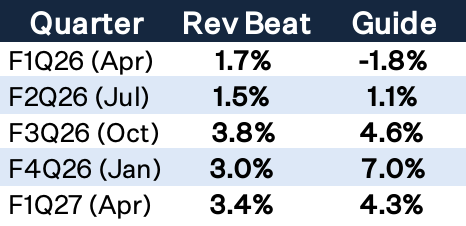
The July print is a near non-event outside of how much they beat consensus revenue by. Nvidia guided to $91B, and the Street is looking for $92B (up 97% y/y), and Data Center is expected to be $85B, up 107% y/y and up from $75B in April. Over the last 3 quarters, Nvidia’s guidance has strengthened and if history repeats itself, they’ll guide October revenue up by around 3%.
The bigger upside lever is the cumulative Blackwell and Rubin number. Nvidia raised that target from $500B through 2026 (October 2025) to $1T through 2027 (June 2026). That does not include the standalone Vera CPU, where the company already sees nearly $20B of revenue this year against a $200B market. Folding Vera into the $1T framework would be the biggest source of upside that comes from the earnings call.
2

Data Center vs. ACIE

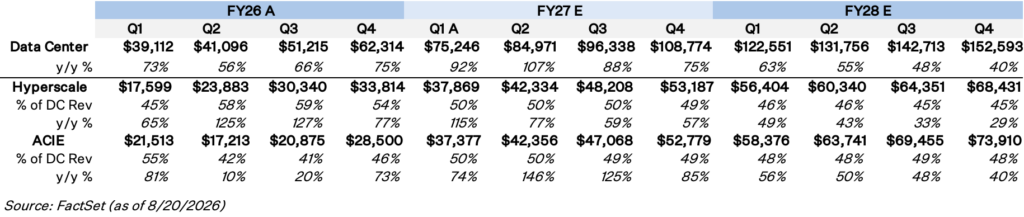
Last quarter, Nvidia split its Data Center segment into Hyperscale—the large public clouds and biggest consumer internet companies—and ACIE (AI Clouds, Industrial, & Enterprise), which includes AI clouds like CoreWeave, plus governments, enterprises, and industrial customers. Nvidia also restated nine quarters of history.

The growth driver within Data Center has shifted to non-hyperscalers. Over the past twelve months, Hyperscale revenue grew 107%, while ACIE grew 46%. Hyperscale’s share of Data Center went from 46% to 55%. In July, the growth script is expected to flip, with hyperscalers growing at 77% and ACIE growing at 146%.

We need to see this trend continuing to give investors confidence that growth higher than the Street is on the table for CY28. The thinking is that the hyperscalers are getting tapped out, and we need to see the rest of the world (ACIE) stepping up.

All of that said, it’s premature to rule out that hyperscalers can carry the Nvidia growth story in CY28. The biggest X factor is, pun intended, SpaceX. SpaceX is on pace to become the fifth hyperscaler horseman in the Nvidia conversation.

In terms of Nvidia’s hyperscaler customers, there are the four horsemen: Amazon, Google, Meta, and Microsoft. These four represent roughly 80% of Nvidia’s data center revenue. The other 20% comes from the next three largest customers—Oracle, OpenAI, and SpaceX (xAI)—and the rest of the pie. I believe SpaceX is becoming the fifth horseman in this conversation, becoming more important than Oracle after announcing they’re becoming Nvidia-exclusive on their first public earnings call earlier this month. SpaceX is estimated to spend $75B more in capex in CY27 over CY26, which would add 29% to the incremental hyperscaler dollars in CY27 over CY26. In other words, SpaceX is a meaningful part of Nvidia’s hyperscaler conversation.

Another way to look at it: SpaceX, I estimate, accounted for about 4% of revenue in July and has the potential to become a 10% customer by the end of CY27. That means that SpaceX alone can drive hyperscaler growth in CY27 to above 68%, compared to the Street, which is currently at 38%.

3

Margins

Nvidia is running at peak margins, with gross margin at 75.1% in January and 75.0% in April. CFO Kress guided July to 75% and told investors the full year would still be around 75%. The Street is expecting 74.8% in October and 74.7% in January.

Two forces suggest there is slight downside to those numbers. First, memory prices have moved sharply higher, and Nvidia has responded by trimming memory configurations on Vera racks. When a company redesigns a product to use less of an input, the input is expensive. Second, Rubin ships for the first time in October and ramps through January, and early yields on a new architecture are never the best yields Nvidia will get.

A dip to 73% or 74% on the Rubin ramp should be in the back of investors’ minds and therefore represents limited downside risk to the stock going into the print.

4

China

It’s worth noting that the Street does not expect any China revenue in the July quarter or going forward. Revenue from China ended in the April 2025 quarter. That said, China is such a massive opportunity, about a quarter of global GPU spending, that the topic of when Nvidia can get back in there is almost guaranteed to come up on the call.

On Thursday, Aug. 20, The Information reported that Nvidia is planning to start small-batch shipments of an AI chip specifically designed for China by the end of the year. A spokesperson for Nvidia commented on the report saying that it was not correct. My thinking is where there is smoke, there is likely fire. I believe Nvidia is trying to find a way forward to restart China revenue and, over the next couple of quarters, may well find a way to do just that. The only problem is that the rollercoaster China/Nvidia news cycle over the past 15 months leaves investors unlikely to have confidence that they can count on revenue from the region long term.

Disclaimer

Back To Top