
Skip to content
Meta’s AI Glasses Need More Than a Display
Meta
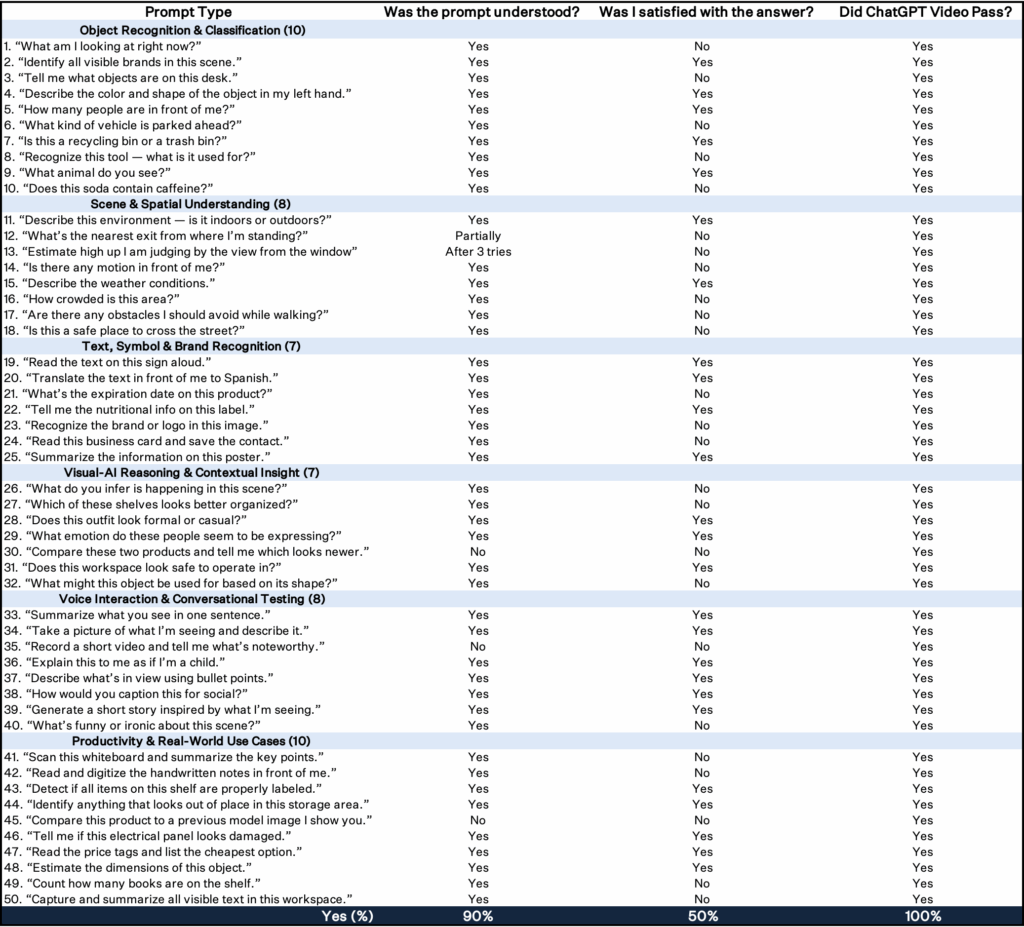
At Deepwater, we own shares of META, and we believe the company is well-positioned to leverage AI at scale to drive ad-revenue growth. That said, I’m disappointed in one of the company’s most recent AI products. We tested Meta AI running on the new Meta Display in a side-by-side comparison against ChatGPT’s video conversation tool running on an iPhone. Meta AI understood about 90% of prompts and delivered satisfactory answers roughly half the time, while ChatGPT understood 100% of prompts and provided satisfactory responses 98% of the time.

Key Takeaways

In 50 side by side prompts, Meta AI felt like it was guessing while ChatGPT performed like an expert.
Meta AI is hard to summon and often ignores what is in front of you.
When asked to interpret a simple cartoon, Meta AI labeled the image while ChatGPT actually engaged with the joke.
I still support Meta’s nearly $18B in annual spending on Reality Labs because I believe AI-powered wearables will become a large market.
1

The Scoreboard: Meta AI vs ChatGPT

On November 13 we wrote that Meta’s new Display glasses will leave you impressed by the tech but short on reasons to use them. One of the key takeaways from that piece was blunt: Meta AI, a primary selling point, felt largely useless compared to ChatGPT or Grok. (See: Meta’s Wearables Have a Long Way To Go)

After that article, we set up a more structured side by side test: 50 prompts run through Meta AI on Meta Display, and the same 50 prompts run through ChatGPT’s video conversation tool on an iPhone. Across the prompts, Meta AI on the Display understood the request about 90% of the time, and I was satisfied with its answers only around half the time. ChatGPT, using its video model, understood 100% of the prompts and delivered satisfactory responses 98% of the time.

I found Meta AI is not just behind on edge cases, it struggles with basic comprehension which makes it broader line usefulness in everyday tasks. The one bright spot for Meta AI was foreign language translation.

2

The Struggles

For starters, I felt something off before the first answer arrived. Summoning Meta AI on the Display is harder than it should be, with the assistant sometimes responding as if it heard you but clearly not seeing what you’re pointing at, and other times asking if you want to take a picture instead of simply using the live view. That leads to a clumsy loop of canceling the photo, restating the request, and trying again, which turns what should be a quick, natural interaction into a small workflow you have to manage.

Once the conversation starts, the most concerning pattern is that Meta AI regularly answers vision based questions without using vision. When comparing items in view to how Meta AI is responding, Meta AI often answered so quickly and you could tell it was guessing rather than observing.

On decision prompts like “Which of these should I choose?” it tended to ignore the visible details and fall back to generic advice. When asked to describe my environment, it replied with a generic line like “Looks like you are indoors” and a stock image and definition of indoor spaces, while ChatGPT described the actual office layout, lighting, and objects.

For a product that sells itself as an AI layer on top of your real world, an assistant that doesn’t reliably look before it speaks is a foundational weakness, because it reduces visual computing back to something you could do on a phone. To be fair, translation is one bright spot, and Meta AI handled short phrases and signs well enough to be useful in the moment.

3

The Cartoon Test

The clearest example of the gap between Meta AI and ChatGPT came from a simple cartoon of two people on a tiny island with a palm tree and the caption “Hey! Guess what?”.

Meta AI’s response was, “This cartoon appears to be a simple drawing of a person standing in front of a palm tree, with the caption ‘Hey! Guess what?’. The meaning behind this cartoon is likely humorous.” That reads more like a label on a stock photo than an interpretation, restating what is already obvious and adding “likely humorous,” which tells you nothing about why it might be funny.

ChatGPT’s response: “Absolutely! Let’s break it down again. So in this cartoon, you’ve got these two folks on this tiny little island with a palm tree, and the caption is “Hey! Guess what?” The humor is that kind of surprise element—like maybe they’re realizing something unexpected about their situation. It might be that they thought they were surrounded by water, and now they’re like, “Guess what? It’s not water!” or just something that flips the situation on its head. So it’s just that little twist that makes it funny.”

Clearly, ChatGPT’s response is more thought out and intelligent, but I think the bigger takeaway is realizing AI struggles to understand human creativity and humor.

4

Meta’s Wearable Bet

Meta is betting that AI on your face is the next computing platform. That only works if the assistant is simple to invoke, clearly grounded in what you’re seeing, and specific enough to deliver actionable answers. Our follow-up testing reinforces that Meta isn’t there yet.

The test we performed puts context around how much work Meta AI and the Display glasses still need before these wearables can go mainstream. Consumer adoption won’t hinge on philosophical debates about what AI “understands.” It will come down to a simpler test: does this thing help me more in the moment than my phone does?

At this fall’s Meta Connect keynote, Zuckerberg said, “Glasses are the ideal form factor for personal superintelligence, because they let you stay present in the moment while getting access to all of these AI capabilities that make you smarter, help you communicate better, improve your memory, improve your senses, and more.”

I agree. Now comes the hard part: making it work.

Disclaimer

Back To Top