
Skip to content
Tesla Delivery Preview: A Likely Miss Doesn’t Change the Physical AI Investment Case
Tesla
We expect December deliveries, which will likely be reported on Friday, January 2, to come in at 415k versus the Street at 449k. This would imply deliveries are down 16% y/y, compared with the Street’s expectation of a 10% decline. The difference reflects our model’s adjustment for the expiration of the tax credit in September, which assumes year-over-year growth in September and December will be consistent at down 5%. Ultimately, investors are likely to look past any December-quarter delivery miss, as the results should suggest the auto business is beginning to stabilize.

Key Takeaways

We expect December quarter deliveries to be down 16% y/y, below the Street estimate of down 10%.
Deliveries matter less as investors have bought into Elon’s message that the real value within Tesla is its physical AI.
Street expects 13% delivery growth in 2026. I am expecting flat to up 5% and believe anything above flat will be a win for investors.
1

December Deliveries

We expect December quarter deliveries to be down 16% y/y, below the Street’s estimate of down 10%. This puts December deliveries at 415k, compared to the Street at 449k.

Our estimate is below the Street because we believe growth in the business was similar from September to December after adjusting for the impact of the tax credit sunset in September.

Taking a step back, we believe September deliveries pulled forward 55k units that would have otherwise landed in December or March. For simplicity, we assume all of the pull forward came from the December quarter. That implies growth in September would have been down 5% if not for the 55k impact, a Deepwater estimate, from the ending of the credit.

For December deliveries to be down 5% would imply overall deliveries of 470k. Subtracting the 55k deliveries that landed in the September quarter gets us to 415k in December.

The table below outlines actual deliveries and the corresponding growth rates, along with deliveries adjusted for the impact of the ending of the tax credit.

Source: Tesla quarterly reporting and Deepwater estimates.

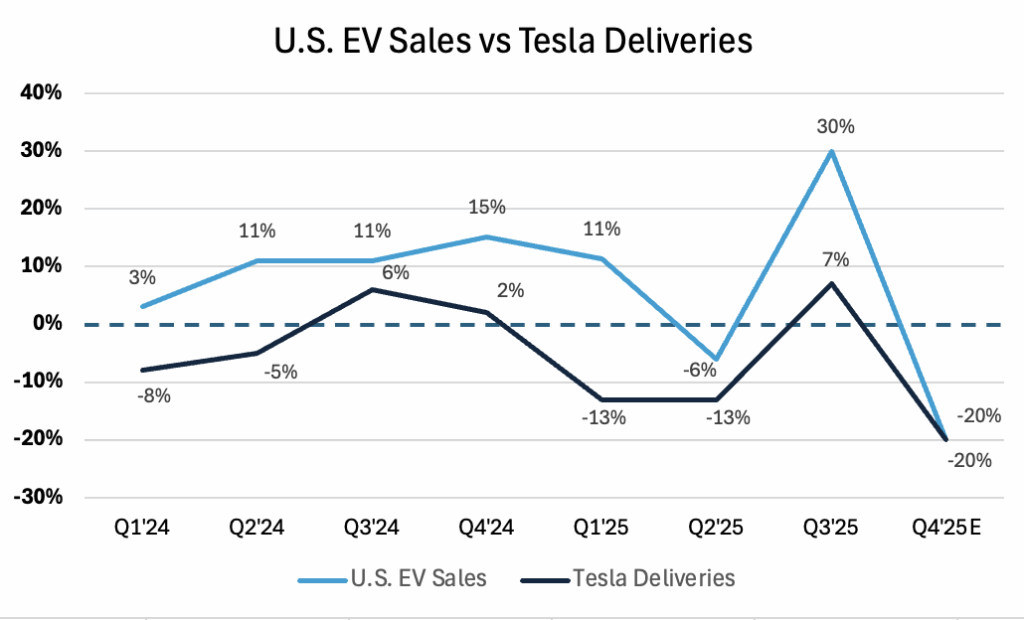
From a market share perspective, if Tesla units are down 16% year over year in December, that would imply market share gains, given Cox Automotive is anticipating overall US EV sales will be down 30% year over year in December due to demand pull forward and a slowing overall new car market.
Source: Cox Automotive, Deepwater Estimates
2

Physical AI Investment Case

Since Tesla last reported deliveries on October 2, shares of TSLA are up 11% versus the Nasdaq up 4%. Over the past six months, shares are up 47%, compared to the Nasdaq up 16%.

This move in the stock price comes as investor expectations for both the December quarter and full year 2026 deliveries have declined. The reason is simple. Investors are increasingly optimistic that Tesla is one of the best investments in physical AI, driven by FSD, Robotaxi, and Optimus.

The bottom line is Tesla’s valuation, trading at a 215x P/E on 2026 earnings with a $1.6T market cap, reflects a sum of the parts premium on AI potential. The central question is less about deliveries and the P/E multiple, and more about what the leader in physical AI should be valued at. From my perspective, I see that target closer to $4T than $1T.

3

2026 Deliveries

Following the December deliveries, the focus will quickly shift to 2026. The Street is looking for 13% growth (1.86m), down from around 20% in the middle of 2025, when investors were expecting the new more affordable model to have an impact. In the end, all Tesla needs to do next year is show that deliveries have stabilized, after likely finishing full year 2025 down around 8%. I am expecting next year’s deliveries to be flat to up 5%.

Over the long term, I believe Tesla can grow deliveries consistently at 15% plus per year, given much of its competition is backing away from investing in EVs. Most recently, Ford sharply reset its EV strategy, canceling three planned EV programs, including a next generation full size electric pickup, a US commercial electric van, and a European electric van. Ford also ended production of the current F 150 Lightning and canceled a roughly $6.5B EV battery supply agreement with LG Energy Solution. These moves leave the door open for Tesla to gain auto market share as EVs begin to regain favor in the coming years.

Disclaimer

Back To Top